
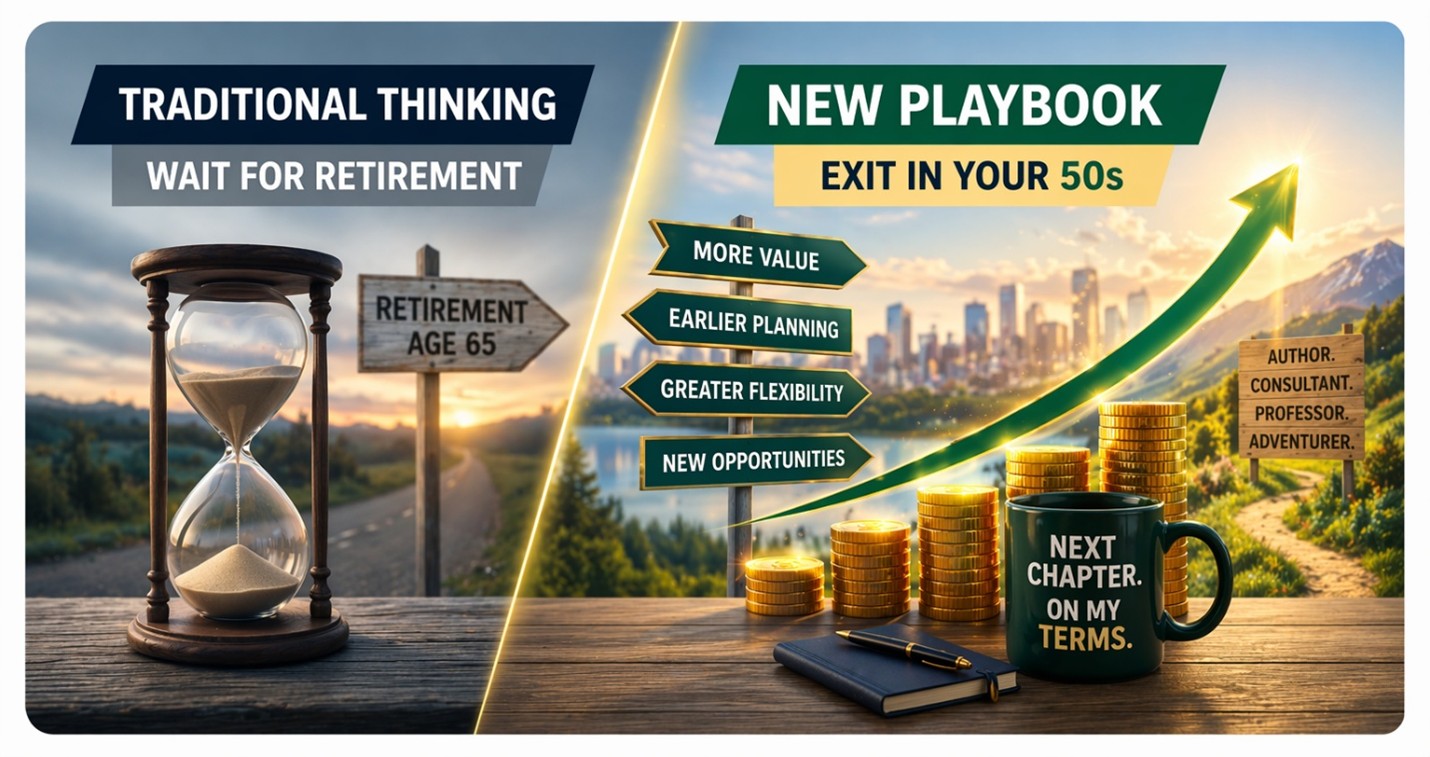
Every business owner will exit their firm—by choice or by circumstance. More A/E owners are choosing to exit in their 50s to pursue new opportunities and passions. Advanced planning and evolution of transition strategies are creating greater flexibility for those who seek an early exit.
The Exit Landscape for A/E Firm Owners Has Changed
Most A/E owners assume they will follow a familiar path to transition—build the firm, transition ownership internally, and exit somewhere in their 60s. That playbook is no longer reliable.
Every business owner will exit their firm—by choice or by circumstance. Increasingly, more owners are choosing to exit in their 50s to pursue new opportunities and passions. What has changed is not the existence of transition options, but the environment surrounding them. Advances in planning, rising valuations, and the evolution of transition strategies have created greater flexibility for those who approach exit planning strategically.
The traditional benchmark of waiting until retirement age to cash out ownership is losing relevance. More forward-thinking owners are executing transitions in their mid to late 50s—on their terms, not by default. Many are moving from successful A/E leadership roles into new chapters as authors, professors, consultants, and even ministers—pursuing meaningful next phases of life with financial security and years of productivity ahead.
This shift is being driven in part by Gen X owners (46–61), who have watched Baby Boomers navigate complex, often prolonged transitions with limited flexibility. As a result, they are planning earlier and evaluating their options more deliberately.
While the primary transition paths—internal succession, ESOP, and third-party sale—haven’t changed, the forces shaping how they are executed have. Shifts in capital availability, buyer sophistication, valuation methodologies, and workforce dynamics have fundamentally redefined how each option performs.
At first glance, the options may appear similar. In practice, they are not.
| Internal Succession | ESOP | Third Party Sale | |
| Sale Price | Internal Value (60% of Market) | Fair Market Value (~80% of Market) | Market Value |
| Liquidity Timing | Slow (8 to 12 years) | Moderate (5 to 10 years) | Faster (1 to 3 years) |
| Tax Liability | Varies (25% to 35%) | None (if structured properly) | Varies (25% to 35%) |
| Control | Financial & Operational Control | Control with oversight | Operational but not Financial |
| Access to Industry Knowledge | Limited | Limited | High |
| Ideal Planning Horizon | 10+ years | 5 to 10 years | 1 to 3 years |
Even though the options may look the same, owners can no longer rely on past assumptions to evaluate them. The environment around them has fundamentally changed—and understanding how these forces impact execution is now critical.
Internal Succession: Preserving Culture and Independence
For decades, internal succession was the default transition strategy in the A/E industry. Firms were often passed down through family members or purchased by entrepreneurial employees who helped build the firm’s success. These transitions preserved independence, maintained culture, and allowed firms to operate with continuity.
Historically, internal buyouts were also relatively affordable. Firm value was often tied to book value or modest multiples, making ownership attainable for employees and allowing firms to fund transitions internally over time. The tradeoff, however, was a more modest financial outcome—often requiring owners to wait until traditional retirement age to realize full value.
Today, that dynamic has shifted. Ownership value is increasingly established through professional valuation methodologies rather than balance sheet estimates, raising expectations for value realization and aligning ownership with true market performance. As Tracey Eaves, CVA, CBA, CM&AA, notes, consistent annual valuations by an experienced A/E appraiser can help stabilize value and support a more equitable—and often more lucrative—transition.
However, higher valuations come with increased complexity. Younger professionals are often less willing or able to invest significant personal capital, and internally funded transitions place greater strain on company cash flow. As a result, these transitions frequently require longer time horizons—making early planning essential.
Firms that began planning a decade ago are now positioned to execute successfully. Those that have not may face increasing pressure. For many, this has prompted a closer look at alternative strategies.
ESOPs: Balancing Liquidity and Legacy
Employee Stock Ownership Plans (ESOPs) have gained significant traction in the A/E industry over the past decade. In an ESOP structure, ownership shares are sold at fair market value to a trust on behalf of employees, creating broad-based ownership while providing liquidity to the seller. These transactions are typically financed through a combination of bank debt and seller notes.
For owners, ESOPs offer a compelling balance—providing liquidity without requiring personal investment from emerging leaders, while preserving independence and rewarding employees. In addition, ESOP structures offer meaningful tax advantages, which can materially enhance after-tax proceeds.
While the core structure of ESOPs has remained consistent, their execution has evolved significantly. According to Andrew Fejer, Managing Director at Lazear Capital, more sophisticated transaction structures have enabled higher valuations, shorter repayment periods, and faster closings. When combined with tax advantages, ESOP outcomes can be competitive with—or in some cases exceed—traditional market transactions.
That said, ESOPs are not simple. They require experienced advisors, disciplined governance, ongoing compliance, and leadership teams capable of operating within an employee-owned structure. While they can accelerate transitions relative to internal succession, full execution still typically spans five to eight years.
Third-Party Sale: Accelerated Growth and Expanded Opportunity
Selling to a third party—whether a strategic buyer or private equity-backed platform—remains the most direct path to liquidity, often delivering market-level valuations and a faster transition timeline.
Historically, many owners hesitated to sell due to concerns around cultural disruption. Early acquirers often imposed rigid operating models that failed to preserve the elements that made firms successful.
That approach has evolved.
Today, the most successful buyers recognize that value is driven by people, culture, and relationships. As a result, they are investing more heavily in integration planning, leadership alignment, and post-acquisition support. Rather than forcing assimilation, many are focused on partnership—seeking to enhance growth, expand capabilities, and retain key talent.
This evolution mirrors broader changes within the A/E industry. Where firms once relied on “sink or swim” development models, today they invest heavily in training, culture, and long-term growth. Leading acquirers are applying a similar mindset.
For many owners, a third-party sale is no longer simply an exit strategy. It can also provide access to capital, expanded markets, and resources that would be difficult to build independently—while still preserving aspects of the firm’s identity.
However, selling does involve meaningful considerations and risk. Owners typically relinquish financial control, and earn-outs or retention agreements may require continued involvement to achieve full value. Ultimately, the success of a transaction is less about financial terms alone and more about fit—driven by strategic alignment, partnership, and disciplined integration planning.
Choosing the Right Path
There is no universally “best” transition strategy—but there has never been more flexibility in how and when owners can exit.
The primary paths remain the same. What has changed is how they perform.
Rising valuations, earlier planning, more sophisticated structures, and a shift toward partnership-driven outcomes have expanded the range of viable strategies. Owners who understand these dynamics can transition earlier, with greater control, stronger financial outcomes, and better alignment with their personal goals.
The old playbook assumed time was the primary lever. Today, strategy is.
And for those who plan accordingly, the opportunity is not just to exit—but to do so on their own terms.